
Girusha Jain & Marjita Mahanta*
If you live in Delhi and happen to see an eagle, chances are it’s not an eagle at all; it’s a Black kite (Milvus migrans)! And when you think you’ve seen a parrot – nope, it’s a Parakeet! Welcome to this world of carefully observing birds and trying to identify them (all the while not forgetting to have fun of course), commonly known as Birdwatching or Birding.
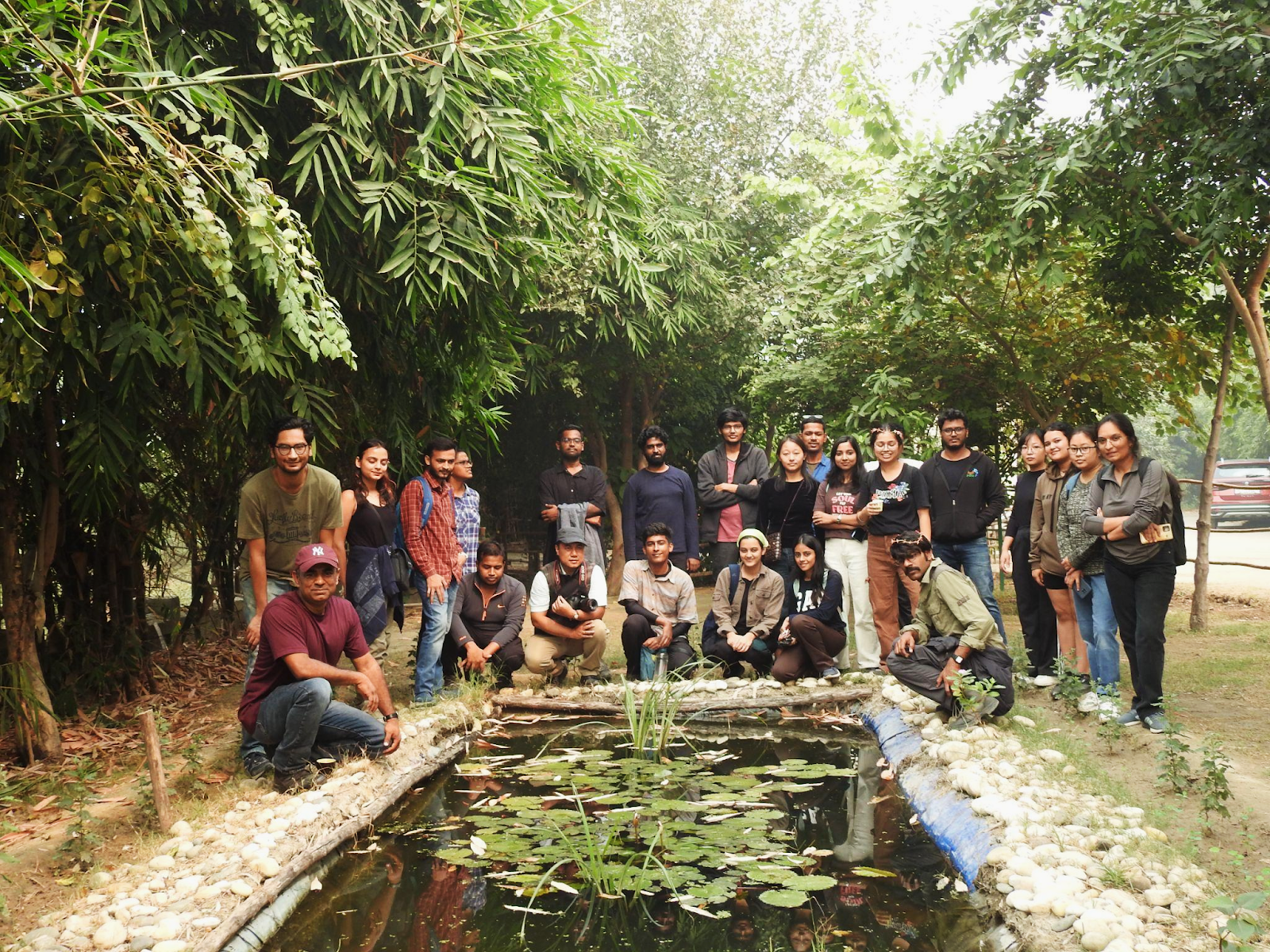
Let us take you on an experiential journey of birding at the Dheerpur Wetland Project Site (DWPS) with the enthusiastic first semester students of MAED (Masters in Environment and Development). A big thank you to Prof. Suresh Babu, Director, CUES and the researchers of AUD who not only introduced us to birding, but took the time to accompany us on a morning of birdwatching as part of a field trip organised by the Centre for Urban Ecology and Sustainability (CUES) on 4th November 2023.


The students gathered at the Dheerpur Wetland site early to catch the heightened bird activity of the morning. After a brief introduction to the Dheerpur Wetland Restoration project, the students were divided into groups of 4-5 people and issued binoculars. With much anticipation and eagerness to catch the enamoring sight of the morning birds, we started our quest.

As we started our journey, all we could hear was a crass cacophony of chirping, but as we wandered much deeper into the site, that cacophony turned into a euphony of sweet bird calls. Such is the magic of birding!
We tried to focus on listening to the mild bird calls and gingerly spotting any minor activity in the trees to catch the littlest of birds. It was exciting to be able to differentiate birds on the basis of minute features like colour, beak, tail, size and their respective calls. With PhD scholars as our mentors, we learnt how to read the bird book, identify species and look for bird activity in dense areas. On this expedition, each group encountered around 20 to 25 different species of birds in the area, which in an urban setting and in the extremely polluted city of Delhi, was in itself a thing of amazement!
The birds we spotted included the Booted Warbler (Iduna caligata), Alexandrine Parakeet (Psittacula eupatria), Red-Whiskered Bulbul (Pycnonotus jocosus), House Crow (Corvus splendens), Ashy Prinia (Prinia socialis), Large-billed Crow (Corvus macrorhynchos), Oriental Magpie Robin (Copsychus saularis), Jungle Babbler (Turdoides striata), Eurasian Collared Dove (Streptopelia decaocto), Red Wattled Lapwing (Vanellus indicus), White-throated Kingfisher (Halcyon smyrnensis), and Pied Myna (Gracupica contra), to name a few.


As we ventured from the dense areas into the open fields, there was one bird call that echoed around us, but we couldn’t recognize it or see the bird. Each one of us excitedly looked here and there looking for the littlest of signs, standing still to carefully examine our surroundings. And there through the eyes of the binoculars, we saw it – the White-throated Kingfisher sitting at the top of a far-off tree in all its glory. What a majestic sight it was! We learnt the very important virtues of patience and keen observational skills for birding.

After an hour or so, we all returned to our initial meeting spot and took a break, where the researchers’ team had arranged oh-so-needed tea and snacks. After taking a breather, we embarked again on a walkthrough through the site to understand how the restoration of the area was carried out, from how CUES acquired the site and what the initial landscape was like, to what flora was purposively planted to help restore the wetland.
We learnt the mighty tale of the rebirth of the restoration site within 7-8 months of a massive fire breaking out and consuming almost all the flora along with the years-long efforts of the CUES team. We were enthralled by the look of pride in the eyes of the professor and the research team as they described how their efforts of planting a fire-resistant bamboo (Dendrocalamus hamiltonii) saved the rest of the site.

On our way to the site’s water bodies and marshes, we were introduced to a plethora of tree and grass species like Acacia, Bombax ceiba (commonly known as the Silk Cotton Tree), Poplar trees at the boundary (which act as bioscreens), Nyctanthes arbor-tristis (Parijaat/ Night Jasmine), Leucaena, and Butea monosperma (Palaash/ Flame of the forest) to mention a few. The last step of the walkthrough was the marshes where we came to know what wetland succession is and how it is achieved in an urban setting like Delhi.


Back at the field station with more ‘chai and samosas’ for hungry tummies, we all engaged with the CUES team to learn more about birding, migration patterns and seasons, deciphering bird calls, what goes on behind a restoration project, the hurdles that come up and what fruit it bears at the end… Our curiosity after such an informative birding excursion was thus quenched.

It is meticulous efforts like these that can leave an imprint for a lifetime in the world of conservation – in creating awareness about our surroundings, fostering empathy for the planet and sowing the seeds of passion in nascent minds for tackling issues posed by a climate-vulnerable Earth. This was illuminating especially to those students who up to this point had not realised that development and environmental conservation could go hand in hand. The professors along with the scholars and other workers are doing a commendable job in instilling this idea in emerging minds who can further go into the world empowered by the myriad of experiences this school provides and be the torchbearers of change that this wounded planet desperately needs.

Featured Image Credit: Maansi
AUTHORS’ BIO
* Girusha and Marjita are first year students pursuing their Masters in Environment and Development from Dr. B.R. Ambedkar University, Delhi.