
The Anthropocene is a buzzword of our times. The term is used to define a new planetary epoch, one in which humans have become the dominant force in shaping Earth’s biogeophysical composition and processes (Chua & Fair, 2019). A 2017 study asserts that Earth’s sixth mass extinction event is more severe than perceived (Ceballos, Ehrlich, & Dirzo, 2017). The study suggests that Earth is experiencing a huge event of population decline and extirpation, which will lead to far-reaching repercussions on the functioning of the ecosystem vital for sustaining the civilization. In line with this study, a body of credible knowledge exhorts us to believe that nature is dying in the Anthropocene.
Nature in the Anthropocene
However, Menno Schilthuizen wants us to believe otherwise; rather, it would be more appropriate to argue that he presents a more problematized image of nature in cities, which are one of the starkest manifestations of the Anthropocene. In Darwin Comes to Town: How the Urban Jungle Drives Evolution, Menno Schilthuizen argues that cities harbour rich biodiversity, sustain rapid urban evolution, signifying the resilience and adaptability of nature. Nature, which is conventionally considered to exist in distant secluded regions away from anthropocentric activities, is thriving, as per Menno Schilthuizen, in the jungles of concrete. Even though there are no examples from Delhi in the monograph, my lived experience here makes it almost an anathema to believe that cities, which are the most polluted landscapes, can harbor rich biodiversity. Yet the author makes a convincing case, complicating the larger structure of crisis by highlighting the rich tapestry of nature in cities.
Evolution in the Ant(hropo)-hill
Menno Schilthuizen, an evolutionary biologist by training, got intrigued by evolution at an early age. Growing up in a small village near the city of Rotterdam in the 1970s in a landscape full of farms, fields, and swampland, he spent his time bird watching, collecting wildflowers, and insects. His curiosity about evolution came with a flipside of frustration about the slow pace of evolution, a phenomenon that an evolutionary biologist like him may spend his entire life studying based on past patterns, but cannot witness in a lifetime. Charles Darwin had expressed similar frustration, observing that evolution is a slow process that happens over geologic timescales. Darwin mentioned, “We see nothing of these slow changes in progress until the hand of time has marked the lapse of ages.” Based on Darwin’s theory, the dominant understanding suggests that evolution is a process happening over geological ages. On the contrary, Schilthuizen highlights that evolution is not a slow process limited to the so-called pristine regions like the Galapagos Islands. Rather, it is rapidly happening all around us in a landscape entirely created by Homo sapiens– the cities.
Schilthuizen argues that Homo sapiens are the modern-day ecosystem engineers. He considers complex ecosystems engineered by ants, like anthills, and dams by beavers, based on natural resources at par with the ant(hropo)-hill built by humans. He argues that cities are a fully natural phenomenon similar to megastructures built by other ecosystem engineers for their societies. The only major difference between them is that the termites, coral, ants, and beavers have maintained their place at a modest level for millions of years, while the scale of human ecosystem engineering has grown by leaps and bounds over the past thousand years.
Resilience of Nature
Studies suggest that species are evolving in response to far-reaching anthropogenic changes. The cliff swallows that build their nests around highway overpasses have developed a shorter wingspan, safeguarding them from the dense traffic, finds a study based on three decades of data collected on the birds’ population (Williams, 2013). Culex pipiens molestus, commonly known as the London Underground mosquito, is another example of evolution in urban spaces. Originally found in the city’s tube tunnels, this distinct species has been found in many other subway systems around the world. A research scholar studying the mosquito established clear genetic and behavioral differences between the underground and the one above the ground. The ones above the ground hibernate in winter and generally bite only birds, while the underground mosquitoes breed throughout the year in warm tunnels and have an appetite for human blood (Cooper, 2014). Schilthuizen mentions many such examples to highlight the rapid evolutionary processes happening in cities, making them ecologically fascinating in his view. Through such wide-ranging evidence, Schilthuizen makes a compelling case for rapid evolution in urban spaces.
Is nature really thriving in cities?
The memories of animals running for their life when the Kancha Gachibowli forest, one of the last remaining forests in the city of Hyderabad, was being razed, are still fresh. There are countless such incidents of contestation around urban nature in Indian cities. I can reflect only about them, given my geographic position. From Aarey in Mumbai to the recent razing of the forest in Jaipur to make way for modern infrastructure, be it a metro or a shopping complex, is a common place. There is mounting evidence of the shrinking of wetlands in cities, from Sampangi Lake in Bengaluru (Nagendra, 2016) to Ghata Lake in Gurugram (Gururani, 2021), due to urban sprawl. Cities are also infamous for air pollution, making them unfit for the survival of any form of life. In such a larger narrative of ecological crisis, both at the local and the global level. The very thought of nature flourishing is inconceivable, more so in the hubs of dense anthropocentric activities. Often, some ideas are so impactful that they become a lens so dominant that one cannot think beyond them. The idea of the death of nature in the Anthropocene would fall in this category.
Complicating the idea of a crisis of nature, Schilthuizen offers a fresh perspective on nature in the city, like all great scholarly ideas that provide a novel frame of thinking contrary to the dominant thought of the time. He convinces the reader to rethink the human ecology of urban spaces, making the monograph a valuable addition to the existing body of knowledge on evolution and urban ecology. He must be credited for underlining the resilience of nature in response to a world rapidly shaped by human actions.
References:
Schilthuizen, M. (2018). Darwin Comes to Town: How the Urban Jungle Drives Evolution. Hachette.
Ceballos, G. P. Ehrlich, & R. Dirzo. (2017). Biological annihilation via the ongoing sixth mass extinction signaled by vertebrate population losses and declines. PNAS.
Chua, L. and H. Fair. (2019). Anthropocene. In The Cambridge Open Encyclopedia of Anthropology. (https://www.anthroencyclopedia.com/entry/anthropocene)
Nagendra, H. (2016). Nature in the city: Bengaluru in the Past, Present and Future. Oxford University Press.
Gururani, S. (2021). Making Land Out of Water: Ecologies of Urbanism, Property, and Loss. In Death and Life of Nature in Asian Cities. (Ed) Rademacher, A. and K Sivaramakrishnan. Hong Kong University Press.
Nitnaware, H & S. Chauhan. (2024). Wildlife population plunges close to point of no return, 73% lost in 50 years: WWF’s 2024 Living Planet report. Down To Earth. https://www.downtoearth.org.in/wildlife-biodiversity/wildlife-population-plunges-close-to-point-of-no-return-73-lost-in-50-years-wwfs-2024-living-planet-report
Carrington, D. (2024). World’s top climate scientists expect global heating to blast past 1.5°C target. The Guardian. https://www.theguardian.com/environment/article/2024/may/08/world-scientists-climate-failure-survey-global-temperature
How animals and plants are evolving in cities. A TED talk by Menno Schilthuizen. (2020) https://www.youtube.com/watch?v=YW1-7OFolJg&t=27s
Williams, S. (2013). Cliff Swallows Evolve to Avoid Traffic. WIRED https://www.wired.com/2013/03/cliff-swallow-evolution/
Cooper, Q. (2014). Subway evolution: What lurks below. BBC. https://www.bbc.com/future/article/20120523-what-lurks-below
Pisharody, R. (2025). Kancha Gachibowli land issue: All you need to know about the protests in Hyderabad. The Indian Express. https://indianexpress.com/article/explained/kancha-gachibowli-forest-issue-9926884/
Khelkar, P. (2022). Aarey colony dispute: 2141 trees already cut, Mumbai Metro to go ahead with construction. India Today. https://www.indiatoday.in/india/story/aarey-milk-colony-tree-felling-supreme-court-mumbai-metro-construction-1607037-2019-10-07
मोइन, मो. (2025). जयपुर में जंगल उजाड़कर मॉल और होटल बनाने की तैयारी, पेड़ कटने के विरोध में सड़कों पर उतरे लोग. ABP News. https://www.abplive.com/states/rajasthan/jaipur-news-malls-and-hotels-built-by-cutting-trees-in-forest-people-protested-ann-2953114
13 of world’s 20 most polluted cities in India; Delhi most polluted capital: report. (2025) The Hindu. https://www.thehindu.com/news/national/13-of-worlds-20-most-polluted-cities-in-india-delhi-most-polluted-capital/article69316060.ece
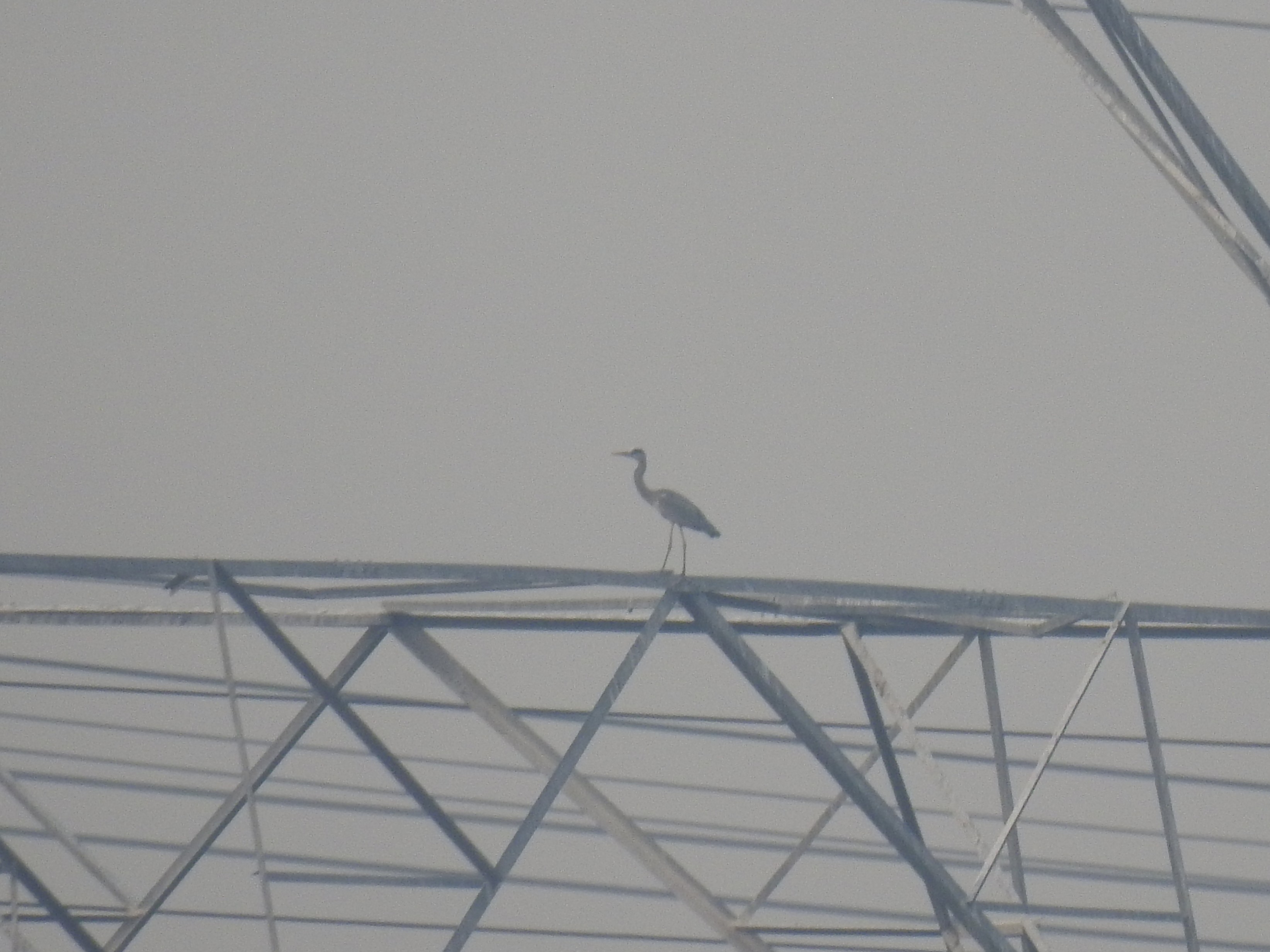
Featured Image: A Grey Heron perched on a power transmission tower at Najafgarh Lake. (Image credit: Nirjesh)
About author:
