
During my internship, I worked in Delhi’s urban parks, places I hadn’t initially considered ecologically significant. Though the city’s lakes caught my attention first, it was the birds that truly transformed my viewing of urban nature. What began as a routine two-credit assignment turned into a deeper exploration of biodiversity in seemingly ordinary green spaces, and a summer internship inquiring the same. This blog summarizes key findings from my internship project where I, through the lens of Theory of Island Biogeography, aimed to understand the relation between geographic factors such as size and proximity of three urban parks and bird diversity of Delhi.
The Theory of Island Biogeography, propounded by MacArthur and Wilson in 1967, explains how the number of species on an island is determined by a balance between immigration and extinction rates. Larger islands located closer to the mainland tend to host more species due to higher immigration rates, while smaller or more isolated islands support fewer species. This highlights the crucial role of island size and distance from the mainland in shaping biodiversity patterns. This concept can be better understood by the following illustration. In this example, three islands of roughly equal size—initially devoid of species—are positioned at varying distances from the mainland, which hosts many species.

Since extinction rates are assumed to be identical across all islands, differences in species richness depend solely on immigration from the mainland or nearby islands. Consequently, islands located farther from the mainland tend to have lower species richness than those situated closer to it.
During this internship, I aimed to explore how factors such as size and proximity to woodlands influence bird diversity in parks of Delhi. Three parks (islands) were selected based on differences in size and distance from the nearest woodland (mainland), and standard bird survey methods were employed to record both species richness and individual abundance (Bibby et al., 1992).


Vaibhav (batchmate) and I conducted such surveys using binoculars on non-windy mornings and evenings to ensure consistency. To assess variation in bird diversity within and across parks, standard diversity indices were calculated and compared. Species–area curves were generated to test the relevance of TIB, and correlations were examined between species abundance, park area, and proximity to forested patches. (For more details regarding the methodology, read the pre-print here.)
Rich Avifaunal Diversity in Small Parks
Small urban parks host a surprisingly high number of bird species. A total of 25 bird species were recorded in Lodhi Gardens (LG), 20 in Buddha Jayanti Park (BJP), and 12 in Bandarwala Park (BWP). This could be due to various factors such as greater size or favourable perimeter-to-area ratio and many more other crucial variables. The finding is striking because it shows that biodiversity persists even in relatively small and human-dominated spaces. For instance, BWP—the smallest park—supported nearly as many species as BJP, challenging assumptions that only large patches sustain diversity.

Comparison of avifaunal richness, abundance, patch area, distance from woodland, and richness-to-area ratio (P/A ratio) across three Delhi parks. The results highlight that species richness (total number of species) does not scale neatly with park size or proximity to woodland, suggesting that additional factors might be influencing bird diversity.
Species–Area and Species-P/A ratio relationship: A Mismatch in Cities
As discussed, the size of the fragment and its distance from the mainland are traditionally considered the most important determinants of species richness. Yet, in these Delhi parks, the classic species–area pattern did not stand ground. Despite BJP and LG being similar in size, LG exhibited higher species richness. Even more surprising, BWP, the smallest park, hosted species numbers comparable to BJP, despite the latter’s proximity to a woodland.

Further, perimeter-to-area (P/A) ratios also varied. In the following graph, BJP had the lowest, suggesting reduced edge disturbance, while BWP had the highest, which may explain its lower diversity. The larger the P/A ratio, the greater the spillover effect, leading to more disturbance and thus less diversity. For LG, however, species richness increased with the P/A ratio. This is interesting because conventionally, following the Theory of Island Biogeography, for the given area, P/A Ratio and distance from nearest woodland, BJP should have more diversity.

Other factors at play
Several factors may explain the deviation from classic TIB: disturbances such as the Kanwar Yatra during the data collection period; flooding in Delhi a few weeks earlier,
could have influenced bird presence. Following local factors also appeared to play a greater role than patch size or isolation in shaping bird diversity:
Habitat Quality & Vegetation Age: Older parks with mature vegetation supported more species. Coppersmith Barbets, for example, were observed only in older trees with sparse canopy, highlighting the importance of tree age and structure.

Degree of “Parkification”: Though not quantified, the degree of “parkification”—how landscaped or managed a park is, also seemed to matter. Older, less manicured parks supported more species, while newer or heavily altered ones showed reduced diversity.
Human Activity: Expected urban associates like Mynas and Crows were common around food waste, but sightings of Rufous Treepies and Black Kites feeding on anthropogenic food items point to expanding synurbization and the growing influence of human-provided food on bird communities.

The findings suggest that the Theory of Island Biogeography (TIB) alone cannot adequately explain avifaunal diversity in Delhi’s urban parks. While patch size and proximity to other green spaces matter, factors such as vegetation complexity, habitat age, human disturbance, and park management emerged as more decisive influences on bird communities, highlightsing the multifaceted nature of urban ecological dynamics. Understanding biodiversity in cities, thus requires approaches that account not only for spatial configuration but also for habitat quality and socio-ecological interactions (for more details watch this five minute presentation).
Towards Bird-Friendly Cities
As Delhi continues to expand, integrating biodiversity into urban design is no longer optional but essential. Urban green spaces should be seen as functioning ecosystems rather than decorative amenities. Even small, well-vegetated parks, as noted by Tratalos et al. (2007), can sustain diverse bird communities, while parks, gardens, and tree-lined avenues remain critical refuges offering shelter, nesting sites, and food (Belaire et al., 2015). Enhancing native vegetation, improving ecological connectivity through corridors or stepping-stone habitats, and fostering public stewardship can help create more resilient bird-friendly cities. Recognizing parks, wastelands, and even roadside vegetation as legitimate ecological spaces is key to building an inclusive vision for urban conservation.
References:
Bibby, C. J., Hill, D. A., Burgess, N. D., & Lambton, S. (with British Trust for Ornithology & Royal Society for the Protection of Birds). (1992). Bird census techniques. Academic Press.
Dawson, D. G., & Bull, P. C. (1975). Counting birds in New Zealand forests. Notornis, 22(2), 101–109.
Forman, R. T. T., & Godron, M. (1986). Landscape ecology. Wiley.
Glendinning, L. (2017). The Sheep Lung Microbiota [Unpublished degree type thesis]. The University of Edinburgh.
Grimmett, R., Inskipp, C., Inskipp, T., Allen, R., Bowley, A., Byers, C., Cole, D., Cox, J., & Driessens, G. (2011). Birds of the Indian Subcontinent (Second edition). Christopher Helm.
Krishen, P. (with Indian National Trust for Art and Cultural Heritage, & Delhi Tourism). (2006). Trees of Delhi: A field guide. Dorling Kindersley (India).
MacArthur, R. H., & Wilson, E. O. (2016). The Theory of Island Biogeography (With a New preface by Edward O. Wilson). Princeton University Press. https://doi.org/10.1515/9781400881376
Magurran, A. E. (2004). Measuring biological diversity. Blackwell Pub.
Schilthuizen, M. (2018). Darwin comes to town: How the urban jungle drives evolution (First U.S. edition). Picador.
Smith, B., & Wilson, J. B. (1996). A Consumer’s Guide to Evenness Indices. Oikos, 76(1), 70. https://doi.org/10.2307/3545749
Tratalos, J., Fuller, R. A., Evans, K. L., Davies, R. G., Newson, S. E., Greenwood, J. J. D., & Gaston, K. J. (2007). Bird densities are associated with household densities. Global Change Biology, 13(8), 1685–1695. https://doi.org/10.1111/j.1365-2486.2007.01390.x
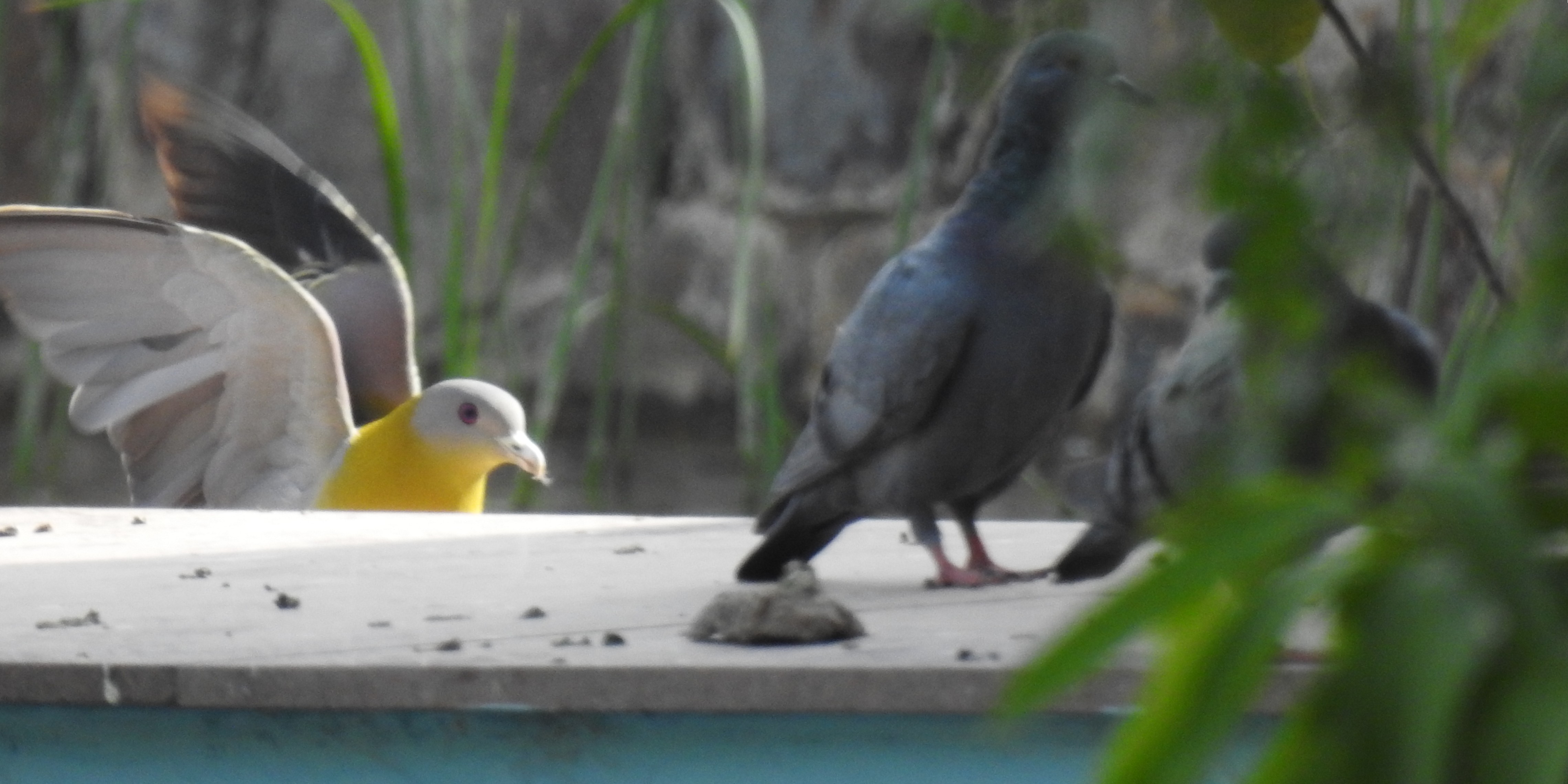
Featured Image: A Yellow-footed Green Pigeon in the background with feral pigeons in the foreground, highlighting the ecological tensions of bird life in urban areas. (Image credits: Nirjesh)
About the author
