
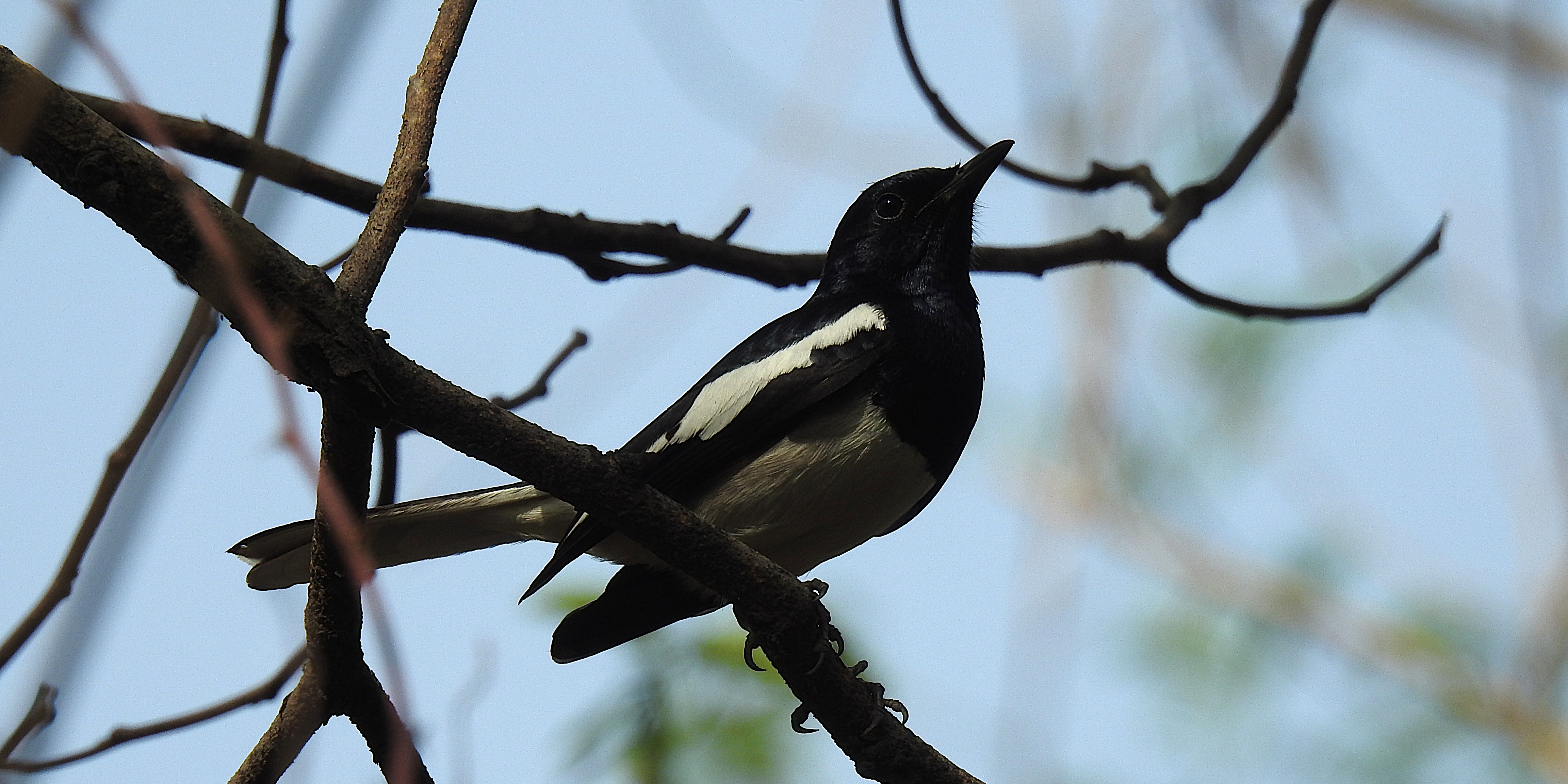
At 2 a.m., when the city seems finally at rest, a sudden drawn-out whistle pierces the silence—sweeeeeeeeeee.
It is the Oriental Magpie Robin (Copsychus saularis), a bird many may never have noticed in flight, yet one whose voice is etched into the urban soundscape. By day, it is a striking figure in black and white, the male with glossy black plumage, the female softer in grey. But in the stillness of night, it is only their song that remains, threading through the city like an echo of the wild.
I still recall one particular evening, returning from a bird-watching session at Dheerpur Wetland Park. Along the trail, where the CUES team had planted rows of bamboo (with foresight to prevent fire spread), dusk was settling in. As the light faded, the rustling of dry bamboo leaves revealed movement — at least five Magpie Robins, foraging for insects. But their presence is not confined to wetlands. Back in Parmanand Colony near Mukherjee Nagar, where I once lived, I often heard their drawn-out whistle, that familiar single-note sweeeeeee, as I walked home from the university in the evenings. These sounds reminded me, again and again, of the overlooked yet persistent forms of nature woven into our daily lives. Now, by consciously attending to them, I notice their perching habits more closely — tail cocked upright, singing melodiously from a branch. In urban spaces, they often take to rooftops, fences, open woodlands, gardens, public parks, and green belts, carving out a place for themselves in the city.
Beyond being a familiar neighbour, the Oriental Magpie Robin carries deep cultural significance across South Asia. In Bangladesh, it is the national bird and widely recognized through cultural symbols, appearing on currency and celebrated in poetry, songs, and folktales. Yet, alongside this reverence lies a darker history of its relationship with humans. The bird is not just associated with its inclusion in the songs; it truly possesses a remarkable repertoire of songs itself. Perhaps, this vocal brilliance has made the species a target of the songbird trade. A report titled Smuggled for its Songs (Chng et al., 2021) documented that at least 26,950 individuals were seized in Indonesia, Malaysia, and Singapore alone between 2015–2020.
Midnight songs in the city
In cityscapes such as Delhi, birds face challenges that often go unnoticed.
For instance, ever since a bright light was installed in the middle of the park near my home in Parmanand, I have heard robins singing in the middle of the night. At first, I thought the bird might be stressed for any number of reasons. But the singing continued. One night I even confirmed with my friends if they had heard it too—and to my surprise, even eBird carried the same nocturnal record.
Curious, I looked for answers in research. While reading a paper on the behavioural ecology of Oriental Magpie Robins in Nepal, I came across a similar observation of night-time singing. The authors suggested that temperature could be influencing this behaviour (Karna, 2013). Other researchers have argued that robins in urban areas sing at night because daytime is simply too noisy (Fuller et al., 2007). The precise cause remains debated, but what emerges clearly is that anthropogenic disturbances particularly light is reshaping the temporal and perhaps spatial rhythms of birds in ways that may have adverse consequences.
Artificial Light at Night
Such effects are studied as Artificial Light at Night, or simply ALAN. It refers to the presence of human-made illumination extending beyond natural daylight hours. A globally widespread environmental pollutant affecting not just the immediate vicinity of light source on terrestrial ecosystems (Bennie et al., 2015) but also coastal regions (Davies et al., 2016) and marine protected areas (Davies et al., 2014).
Artificial light scattered in the atmosphere and reflected back to the ground known as skyglow can affect environments tens to hundreds of kilometres away (Davies & Smyth, 2018). Other forms of light pollution include clutter, glare, and light trespass, each affecting species in distinct ways (Karan et al., 2023). This is especially consequential for organisms that depend on large-scale movements for survival and reproduction. For example, light trespass can fragment bird habitats, forcing them to migrate to distant areas in search of adequate nutrition (Falchi et al., 2011). By interrupting natural cycles of darkness, ALAN can disrupt nocturnal behaviours such as foraging, predation, sexual communication, and camouflage (Davies et al., 2013) alter species interactions, and affect processes like melatonin regulation (De Jong et al., 2016). The consequences can also be severe. At Long Point Bird Observatory in Canada, surveys of a nearby lighthouse recorded roughly 600 bird kills during fall and spring migrations alone (Jones & Francis, 2003). Similarly, every year thousands of migratory birds, including American Redstarts, Ovenbirds, Black-and-white Warblers, and Northern Parulas, become disoriented and trapped in the powerful beams of the 9/11 Tribute in Light memorial.
Is the song a cry ?
The growing popularity of white-light LED lamps has intensified these disruptions. Once a modest 9% of the global lighting market in 2011, LEDs were projected to rise to 69% by 2020 (Zissis & Bertoldi, 2014). Yet these energy-efficient models have unforeseen deleterious impacts on both humans and other species. LEDs influence a wider range of biological responses compared to narrow-spectrum sources such as low-pressure sodium lamps (Gaston et al., 2012) because of which they may pose greater ecological risks. The effects of which are particularly visible in bird behaviour. Along an urban gradient from forest edges to city centres, the onset of blackbird (Turdus merula) dawn song can vary by as much as five hours (Nordt & Klenke, 2013), advancing by 1.5–2 minutes for every lux of additional light intensity (Da Silva et al., 2014). Street lighting exerts its strongest influence on species that naturally begin singing earlier in the day, such as the blackbird and the robin (Kempenaers et al., 2010). Seen against this wider backdrop, the robin’s midnight song near my home becomes more than a passing curiosity. It is a reminder that the disruptions traced in ecological studies are also audible in our everyday lives, woven into the rhythms of our own urban nights. When I hear that call, I still wonder, is it a song of resilience, a cry against the city’s light, or perhaps an adaptation we are only beginning to understand?
References
Bennie, J., Davies, T. W., Cruse, D., Inger, R., & Gaston, K. J. (2015). Cascading effects of artificial light at night: Resource-mediated control of herbivores in a grassland ecosystem. Philosophical Transactions of the Royal Society B: Biological Sciences, 370(1667), 20140131. https://doi.org/10.1098/rstb.2014.0131
Chng, S., Sabban, S., Anongrakh, W., & Krishnasamy, K. (2021). SMUGGLED FOR ITS SONG THE TRADE IN MALAYSIA’S ORIENTAL MAGPIE-ROBINS. TRAFFIC, Southeast Asia Regional Office, Petaling Jaya, Selangor, Malaysia. https://www.researchgate.net/publication/355265377_SMUGGLED_FOR_ITS_SONG_THE_TRADE_IN_MALAYSIA%27S_ORIENTAL_MAGPIE-ROBINS
Da Silva, A., Samplonius, J. M., Schlicht, E., Valcu, M., & Kempenaers, B. (2014). Artificial night lighting rather than traffic noise affects the daily timing of dawn and dusk singing in common European songbirds. Behavioral Ecology, 25(5), 1037–1047. https://doi.org/10.1093/beheco/aru103
Davies, T. W., Bennie, J., Inger, R., De Ibarra, N. H., & Gaston, K. J. (2013). Artificial light pollution: Are shifting spectral signatures changing the balance of species interactions? Global Change Biology, 19(5), 1417–1423. https://doi.org/10.1111/gcb.12166
Davies, T. W., Duffy, J. P., Bennie, J., & Gaston, K. J. (2014). The nature, extent, and ecological implications of marine light pollution. Frontiers in Ecology and the Environment, 12(6), 347–355. https://doi.org/10.1890/130281
Davies, T. W., Duffy, J. P., Bennie, J., & Gaston, K. J. (2016). Stemming the Tide of Light Pollution Encroaching into Marine Protected Areas. Conservation Letters, 9(3), 164–171. https://doi.org/10.1111/conl.12191
Davies, T. W., & Smyth, T. (2018). Why artificial light at night should be a focus for global change research in the 21st century. Global Change Biology, 24(3), 872–882. https://doi.org/10.1111/gcb.13927
De Jong, M., Jeninga, L., Ouyang, J. Q., Van Oers, K., Spoelstra, K., & Visser, M. E. (2016). Dose-dependent responses of avian daily rhythms to artificial light at night. Physiology & Behavior, 155, 172–179. https://doi.org/10.1016/j.physbeh.2015.12.012
Falchi, F., Cinzano, P., Elvidge, C. D., Keith, D. M., & Haim, A. (2011). Limiting the impact of light pollution on human health, environment and stellar visibility. Journal of Environmental Management, 92(10), 2714–2722. https://doi.org/10.1016/j.jenvman.2011.06.029
Fuller, R. A., Warren, P. H., & Gaston, K. J. (2007). Daytime noise predicts nocturnal singing in urban robins. Biology Letters, 3(4), 368–370. https://doi.org/10.1098/rsbl.2007.0134
Gaston, K. J., Davies, T. W., Bennie, J., & Hopkins, J. (2012). REVIEW: Reducing the ecological consequences of night‐time light pollution: options and developments. Journal of Applied Ecology, 49(6), 1256–1266. https://doi.org/10.1111/j.1365-2664.2012.02212.x
Jones, J., & Francis, C. M. (2003). The Effects of Light Characteristics on Avian Mortality at Lighthouses. Journal of Avian Biology, 34(4), 328–333.
Karan, S., Saraswat, S., & Anusha, B. S. (2023). Light pollution and the impacts on biodiversity: The dark side of light. Biodiversity, 24(4), 194–199. https://doi.org/10.1080/14888386.2023.2244920
Karna, J. (2013). Behavioral ecology of Oriental Magpie Robin Copsychus saularis. Nepalese Journal of Biosciences, 3(1), 87–89. https://doi.org/10.3126/njbs.v3i1.41452
Kempenaers, B., Borgström, P., Loës, P., Schlicht, E., & Valcu, M. (2010). Artificial Night Lighting Affects Dawn Song, Extra-Pair Siring Success, and Lay Date in Songbirds. Current Biology, 20(19), 1735–1739. https://doi.org/10.1016/j.cub.2010.08.028
Nordt, A., & Klenke, R. (2013). Sleepless in Town – Drivers of the Temporal Shift in Dawn Song in Urban European Blackbirds. PLoS ONE, 8(8), e71476. https://doi.org/10.1371/journal.pone.0071476
Zissis, G., & Bertoldi, P. (2014). 2014 update on the status of LED market. Publications Office. https://doi.org/10.2790/756893
Featured Image: An oriental magpie robin perched on a branch. (Credits: Nirjesh)
About the author
